

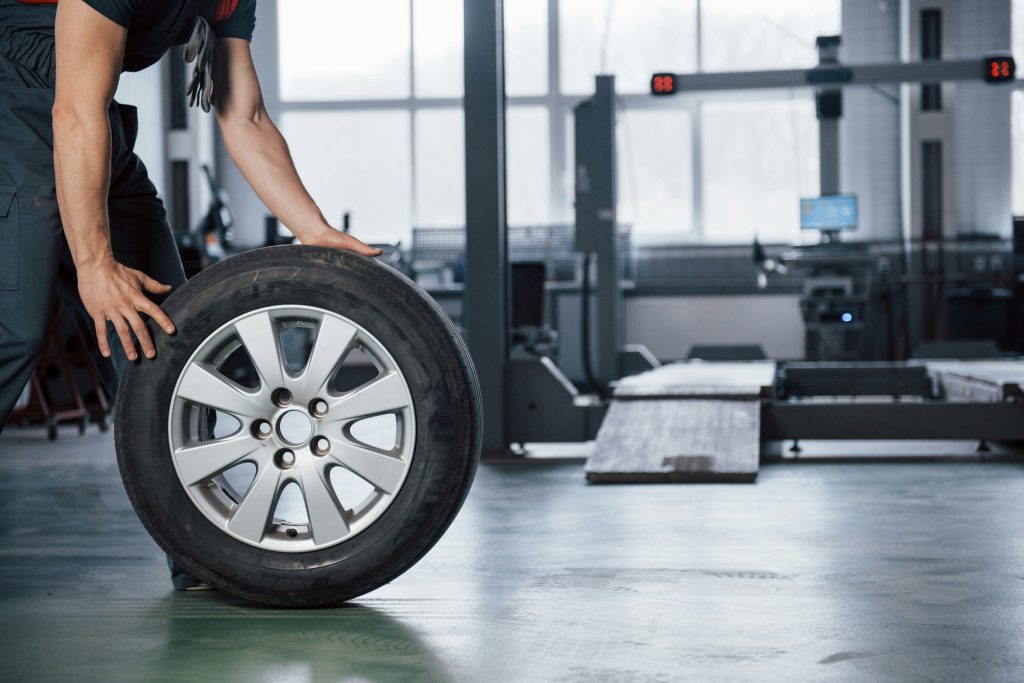
Tire rotation is the process of systematically changing the positions of your vehicle’s tires from front to back and side to side. Because the front and rear axles of a vehicle experience entirely different forces during acceleration, braking, and steering, tires naturally wear down at different rates. Failing to move them regularly leads to premature tread loss, which compromises your driving safety and forces you to purchase replacements much sooner than necessary.
Consider how a front-wheel-drive vehicle operates during a daily commute. The front tires are responsible for transmitting engine power to the ground, guiding the vehicle through every turn, and absorbing the vast majority of the friction generated during braking. On a standard vehicle, this concentrated workload causes the front tread to disappear much faster than the rear tread. By systematically moving the rear tires to the front and vice versa, you distribute these frictional forces across all four tires over their lifespan.
At our service center, we see firsthand how regular maintenance protects your automotive investment. For instance, drivers operating a new Nissan Rogue with its active front-wheel-drive system will find that routine rotations keep the tread depth balanced, preserving the precise handling of the crossover. Similarly, maintaining even tread on a commuter sedan like the new Nissan Sentra ensures consistent traction on wet pavement, while those driving a new Nissan Altima benefit from a quieter cabin when the tires wear smoothly.
If you drive a heavy-duty truck or a larger family vehicle, tire care is even more critical. The high torque of a new Nissan Frontier or a heavy‑duty new Nissan Titan can rapidly scrub the tread off the drive wheels if they are left in place too long. The same rule applies to spacious family haulers like the eight-passenger new Nissan Pathfinder or the robust new Nissan Armada, where the sheer weight of the vehicle accelerates tread wear. Even highly efficient models, such as the compact new Nissan Versa, the stylish new Nissan Kicks, or the refined new Nissan Murano, rely on balanced tire wear to maintain their factory-specified fuel economy.
This principle is equally vital for electric vehicles, which deliver instant torque to the pavement. Owners of the all-electric new Nissan Leaf or the advanced new Nissan Ariya will notice that the immediate power delivery can accelerate tread wear on the drive axle if rotations are neglected. Even sports car enthusiasts driving the high-performance new Nissan Z must keep a close eye on tire wear to preserve cornering grip. To keep your vehicle performing safely, you can schedule service and diagnostics with our factory-trained technicians, or give our service department a quick call to discuss your vehicle’s specific maintenance schedule. If you want to drop by for an inspection, you can easily find our showroom and service bays located right on Covington Pike.
Table of Contents
- Why Is Regular Tire Rotation Critical for Your Drivetrain and Safety?
- How Often Should You Schedule a Tire Rotation?
- What Are the Early Signs of Uneven Tire Wear?
- Understanding Technical Patterns for Front-Wheel Drive and All-Wheel Drive
- Quick Answers to Common Tire Care and Maintenance Questions
- Schedule Professional Tire Maintenance
Why Is Regular Tire Rotation Critical for Your Drivetrain and Safety?
Consistent tire rotation directly impacts the mechanical health of your drivetrain and the safety of everyone on board. When tires wear unevenly, the overall circumference of each tire changes slightly. On all-wheel-drive systems, even minor differences in tire diameter force the front and rear axles to rotate at slightly different speeds. This constant speed mismatch puts continuous stress on the center differential and transfer case, which can lead to overheating, premature gear wear, and incredibly expensive drivetrain repairs.
From a safety perspective, balanced tread depth is your primary defense against hazardous driving conditions. Tires with uneven wear patterns have a significantly reduced contact patch with the road, which severely compromises wet-weather traction. This lack of uniform grip can lead to:
- Increased stopping distances: When the front tires have significantly less tread than the rear, the vehicle cannot bite into the pavement effectively during hard braking.
- Higher risk of hydroplaning: Shallow, uneven tread grooves cannot channel water away from the tire footprint, causing the vehicle to slide on wet surfaces.
- Compromised emergency handling: Sudden steering maneuvers become unpredictable when the front and rear axles do not share the same level of lateral grip.
In addition to safety risks, skipping this basic maintenance can hit your wallet. Many tire manufacturers require proof of regular rotations at specified mileage intervals to honor their treadwear warranties. Neglecting this service means that if your tires wear out prematurely, you may have to pay full price for a replacement set out of pocket. To help keep your maintenance costs manageable, we recommend checking our current service and parts specials for seasonal discounts on tire care and alignments.
How Often Should You Schedule a Tire Rotation?
A standard recommendation across the automotive industry is to rotate your tires every 5,000 to 7,500 miles [1][3][7]. For the majority of drivers, this interval aligns perfectly with scheduled oil changes, making it easy to remember and combine into a single service visit [1][3][7]. Many modern vehicles feature a mileage-triggered dashboard warning, such as a “Maintenance: Tire” reminder, which is factory-set to appear every 5,000 or 7,000 miles to help you stay on track [4].
However, your specific driving environment plays a major role in how quickly your tires degrade. For example, drivers navigating the stop-and-go traffic and occasional rough pavement in Arlington will place higher stress on their front tires due to constant braking and tight turns. In these demanding suburban and urban environments, sticking to the conservative end of the 5,000-mile interval is highly recommended to catch and correct uneven wear patterns before they become permanent [1][3].
Drivetrain configurations also dictate different schedules. While front-wheel-drive and rear-wheel-drive vehicles can easily run the standard 5,000 to 7,500 miles between services, all-wheel-drive vehicles require more frequent attention. Because all-wheel-drive systems constantly distribute power to all four wheels, they are highly sensitive to tread depth variances. Servicing these vehicles every 3,000 to 5,000 miles helps protect the transfer case and ensures the system operates smoothly.
What Are the Early Signs of Uneven Tire Wear?
Recognizing the early warning signs of tire wear allows you to address alignment or suspension issues before they ruin an entire set of tires. The most reliable way to monitor your tires is to inspect the tread depth across the width of each tire using a depth gauge or by looking for visual wear patterns.
There are several distinct types of uneven wear to watch out for:
- Feathering: The tread blocks feel smooth when rubbed in one direction but rough when rubbed in the opposite direction. This is typically caused by incorrect toe-in alignment settings.
- Camber Wear: One side of the tire tread (either the inner or outer shoulder) is significantly more worn than the center or the opposite side, usually pointing to a misaligned suspension angle.
- Cupping or Scalloping: Dipped, wavy depressions appear around the edge of the tread. This dangerous pattern is often a sign of worn-out shocks, struts, or suspension bushings.
- Center vs. Edge Wear: Heavy wear concentrated strictly in the center indicates over-inflation, while wear on both outer shoulders points to chronic under-inflation.
Beyond visual inspections, your vehicle will often tell you when something is wrong through physical feedback. If you notice a persistent vibration in the steering wheel or through the seat at highway speeds, your tires may be out of balance or wearing unevenly [2][8]. Additionally, an unexplained increase in low-frequency road noise or a slight pull to one side while driving on a flat road are strong indicators that your tires need professional attention [2][8].
Understanding Technical Patterns for Front-Wheel Drive and All-Wheel Drive
The exact pattern used to rotate your tires is determined by your vehicle’s drivetrain and the design of the tires themselves. For standard, non-directional tires on a front-wheel-drive vehicle, technicians typically employ the “Forward Cross” pattern. In this configuration, the front tires are moved straight back to the rear axle, while the rear tires are crossed over to the opposite sides on the front axle (rear-left goes to front-right, and rear-right goes to front-left). This pattern ensures that the directional forces of steering and power delivery are equalized.
For rear-wheel-drive and all-wheel-drive vehicles, the “Rearward Cross” is the industry standard. Here, the rear tires are moved straight forward to the front axle. The front tires are then crossed to the opposite rear positions (front-left goes to rear-right, and front-right goes to rear-left). This specific swap helps balance out the heavy acceleration forces experienced by the rear tires.
Specialty tire setups require unique approaches:
- Directional Tires: These tires feature a tread pattern designed to roll in only one direction, marked by an arrow on the sidewall. They can only be rotated straight front-to-back on the same side of the vehicle to prevent the tread from running backward.
- Staggered Fitments: Some performance vehicles use larger tires on the rear axle than on the front. Because front-to-back swapping is impossible, these tires can only be rotated side-to-side across the same axle, provided they are non-directional.
- Five-Tire Rotation: Vehicles equipped with a matching, full-size spare tire can integrate the spare into the rotation cycle. This ensures that all five tires wear down at an identical rate, which is incredibly useful if you ever need to drive on the spare long-term.
In rural communities like Millington, where drivers frequently transition from paved highways to unpaved gravel roads and muddy farm lanes, maintaining the correct rotation pattern is essential. The varying traction demands of these mixed surfaces can cause rapid, localized tread scrubbing, making precise, drivetrain-specific rotation patterns crucial for maintaining off-road grip and highway stability.
Quick Answers to Common Tire Care and Maintenance Questions
Q: Can tire rotation fix tires that are already severely worn?
No, rotating your tires cannot reverse physical damage or severe, uneven wear that has already worn down to the indicators. If a tire has developed deep cupping, bald shoulders, or exposed cords, it must be replaced. Rotation is a preventative measure designed to keep healthy tires wearing evenly, not a cure for neglected mechanical issues or alignment damage.
Q: Do I need to get my wheels balanced every time I rotate my tires?
While it is not strictly mandatory to balance your wheels at every single rotation, it is highly recommended. Wheel balancing ensures that the weight of the tire and wheel assembly is distributed evenly around the axle. Combining these two services every 5,000 to 7,500 miles prevents high-speed vibrations and protects your suspension components from unnecessary wear [2][8].
Q: Why do my front tires wear out faster than my rear tires?
On most passenger vehicles, the front axle carries the weight of the engine and transmission, handles all steering forces, and manages up to 80% of the braking load. On front-wheel-drive vehicles, these tires also deliver all the engine power to the road. This combination of heavy weight, frictional steering forces, and braking heat causes the front tires to wear down much quicker than the trailing rear tires.
Q: What is the difference between a tire rotation and a wheel alignment?
Tire rotation is the physical act of swapping the positions of the tires on your vehicle. A wheel alignment, on the other hand, is a mechanical adjustment of the vehicle’s suspension angles (toe, camber, and caster) to ensure the tires sit perfectly perpendicular to the road and parallel to each other. Both services work together to maximize tire life, but they address entirely different maintenance needs.
Q: Should I rotate my tires if I just bought a brand-new set?
Yes, even brand-new tires require scheduled rotations. In fact, the initial rotation is one of the most critical because fresh, full-depth tread blocks are highly flexible and particularly vulnerable to rapid, uneven wear as they adjust to your vehicle’s suspension dynamics [2][8]. Getting your first rotation on time sets the foundation for maximum tread life. If you are planning on upgrading your vehicle soon, you can explore our current new car specials to see the latest models equipped with advanced tire pressure monitoring systems.
Schedule Professional Tire Maintenance
Protecting your vehicle’s safety, ride comfort, and fuel efficiency starts with consistent tire care. Skipping routine rotations might seem harmless in the short term, but it quickly leads to accelerated tread wear, compromised wet-weather grip, and avoidable drivetrain strain. Our factory-trained technicians understand the exact rotation patterns, load ratings, and alignment specifications required to keep your vehicle running smoothly.
When you bring your vehicle to our dedicated service department, we do more than just swap your tires. Every service visit includes a thorough inspection of your tire tread depth, a check of the sidewalls for damage, precise pressure adjustments, and a visual inspection of your brake pads and suspension components. This comprehensive approach allows us to spot potential alignment or suspension issues before they turn into costly repairs.
Do not wait until you feel a vibration in the steering wheel or notice bald spots on your tread. Keep your vehicle performing at its best by scheduling a professional tire service today. You can contact our service desk directly by calling (901) 373-2800 to find a convenient time, or drive straight to our service center at 2080 Covington Pike, Memphis, TN 38128 for expert maintenance you can trust.
© 2026 Jim Keras Nissan. All rights reserved.
Connect with us


- 2025 Nissan Frontier
- 2025 Nissan Pathfinder
- 2025 Nissan Rogue
- 2026 Nissan Altima
- 2026 Nissan Armada
- 2026 Nissan Frontier
- 2026 Nissan Leaf
- 2026 Nissan Murano
- 2026 Nissan Rogue
- Earth Day
- Jim Keras Nissan
- Jim Keras Nissan Financing
- Jim Keras Nissan Service
- Memphis Nissan Dealer
- Memphis Nissan Financing
- Memphis Nissan Service
- Memphis Used Cars
- MyNissan Rewards
- Nissan Ariya
- Nissan Car Features
- Nissan Car Service
- Nissan Electric Cars
- Nissan Financing
- Nissan New Car
- Nissan Safety
- Nissan Sentra
- Nissan SUV
- Nissan Titan
- Nissan Versa
- Uncategorized